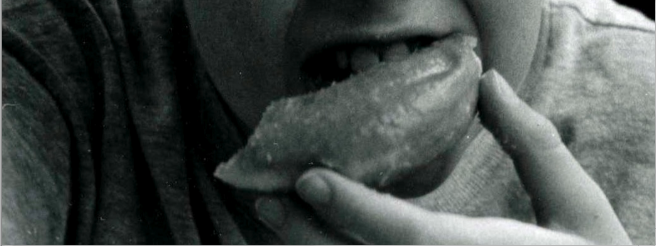
We have just returned from my mom’s birthday dinner, and my fingers still smell of lamb. Earthy – lighter than dirt but deeper than the plants that spring from it. The smell is cavernous and tender, buttery and bloody. It was a wonderful meal, both for the food we ate, and for the company we kept. The courses came and went and we crooned about each one. We just couldn’t help but talk about it!
And it reminded me of something I’ve been thinking about: How exactly to talk about food? And why is it that food writing is so rife with hyperbole? Take, for example, Wednesday’s article “A Stew With a Past and a Future” by Alex Witchel in
The New York Times:
"It is hard for me to cook for people I don’t like. I don’t have to do it often, but when I do, I find it a torment because cooking is so personal, so revealing. Even more than sex, I think. You can have a perfectly good one-night stand, be greatly entertained, and still not know the other person when it’s done. But once someone cooks for you, it’s almost impossible not to discover who that person is. Which may be why most of the dinner parties I go to in New York are prepared by a cook or a caterer."
Wait a minute.
Really? Sex is less intimate than a meal? We, of course, cannot know about the sex that Witchel is having, so we have to assume that these have been some pretty incredible (and revealing) meals. And, indeed, the article goes on to tell us about a meal with Louis Begley, who, it seems, does deliver earnestly heavy, autobiographical and Polish stories and stews.
But why is it that we so often make these grandiose offerings at the royal court of food writing? Is it that food belongs to the realm of the senses, where emotion may excite and incite to the point where we feverishly channel our inner Italian man, kissing the tips of our fingers and releasing them like firecrackers (all the while cooing, “Bene, bene, bene”)? Perhaps it’s because food defies language, which is not its original mistress. If only our tastebuds could speak! It’s as if we try to translate from flavor to adjective and fail utterly, then turn to hyperbole in a last attempt to do justice to the meal’s essence: The lamb was soft.
No, it was rough and real against the backs of one’s teeth! It was earthy.
By God, it was as light as if it had been roasted on the lining of clouds!
Now, I’m not saying I’m never a part of this camp. Clearly, I
am. In fact, I felt a deep chord of connection was strummed within me when I heard André Aciman speak of just such a food epiphany at Russell House last Monday. He was once on assignment in Barcelona, finding the city detestable and un-inspiring. He couldn’t think of a word to write about the place until he went for tapas. He looked at the small slice of toast, layered with a kind of tomato paste, maybe a vegetable or two on top of that, and an olive on top of
that – and he was stunned. “Who could invent this thing with so many layers? I want to talk about the layers ‘cause I’m obsessed with this piece of food,” he admitted to a rapt audience. Yet, he had earlier wondered if just by thinking about it (putting it into words) he was interfering with the plenitude of the Tuscan countryside, brimming with wine of Chianti. There we were again – caught between feeling compelled to speak and unable to do right by our subject.
I think of one the most famous of food moments in print, Proust’s madeleine. To write about food is, indeed, somehow a “remembrance of things past.” Taste is fleeting. No sooner have we suckled the flavors than we have lost them, stubborn though our scented fingers may be and enduring, the memory of them. Remembering Witchel’s lines on the intimacy of breaking bread together, I consulted with the master of food writing, M.F.K Fisher. And she agrees (without all the bombast) that “sharing food with another human being is an intimate act that should not be indulged lightly” [“A is for dining Alone,” in An Alphabet for Gourmets, 1949]. Ultimately, I think food’s very sensuality bespeaks its unspeakable nature and its intimacy – the two are part and parcel of our experience of eating. How hard to capture those moments. How the wonderful the attempt.
Scoozzi Trattoria & Wine Bar1104 Chapel Street
New Haven, CT 06510
(203) 776-8268